Enquiries from Google Ads↗ +155 %
+0%
Aug–Sep 2026 against Jan–Jun 2026, the last half-year on the old website.
old site100
new site255
Enquiry = a sent form or a call from an ad. One yardstick for the whole study.
CarDetailer is a premium detailing studio — paint protection film, ceramic coatings, paint correction. We took over Google Ads on 1 June 2026, cleaned the queries, fixed the geography, threw out soft conversions and capped the budget. The whole of June brought one form enquiry. The ads were not the problem; the website they sent people to was. So we built a new one, around a single action — sending an enquiry. The first one arrived five minutes after launch. Since then enquiries from ads are up 155 % and cost 55 % less.

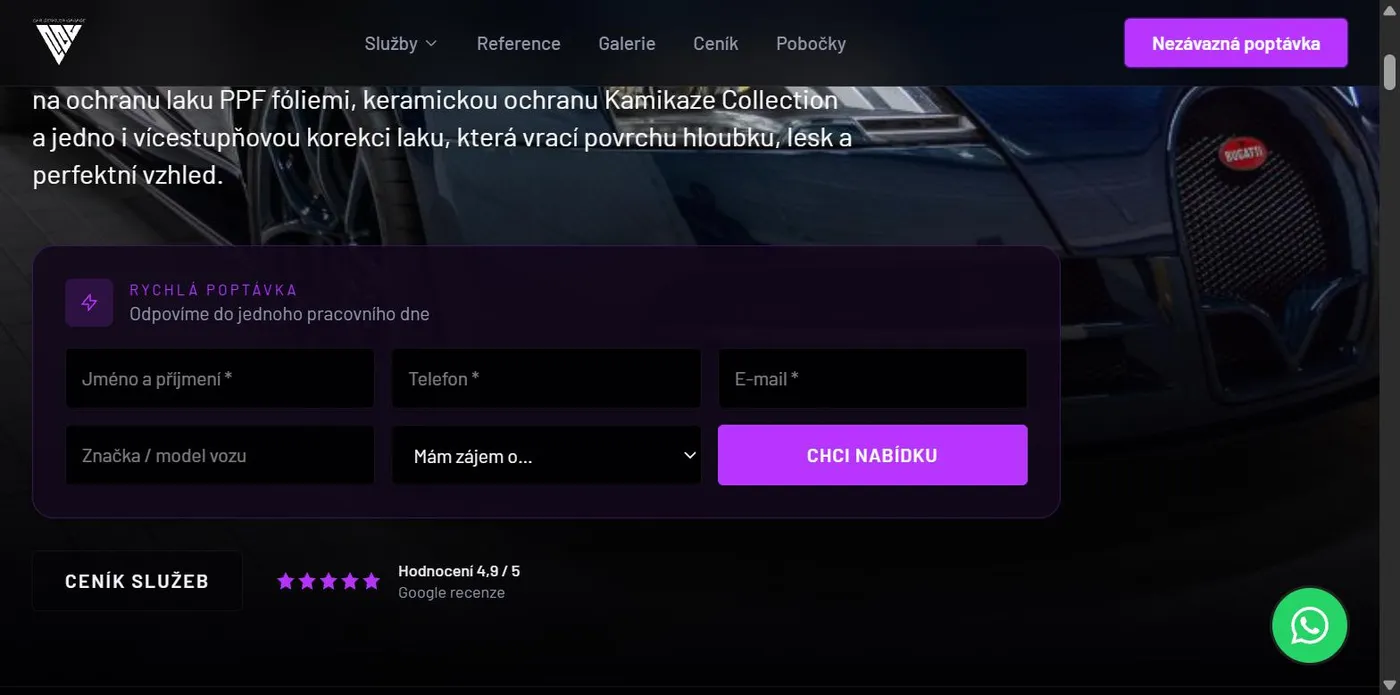
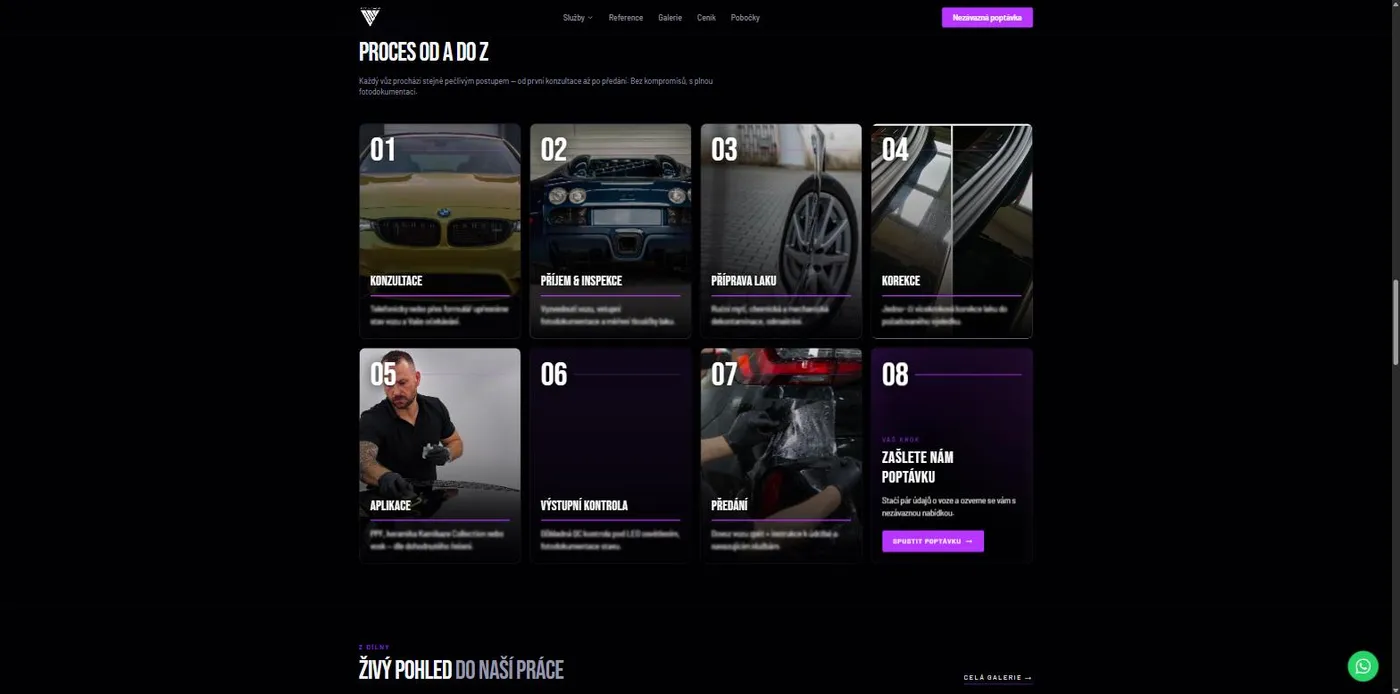
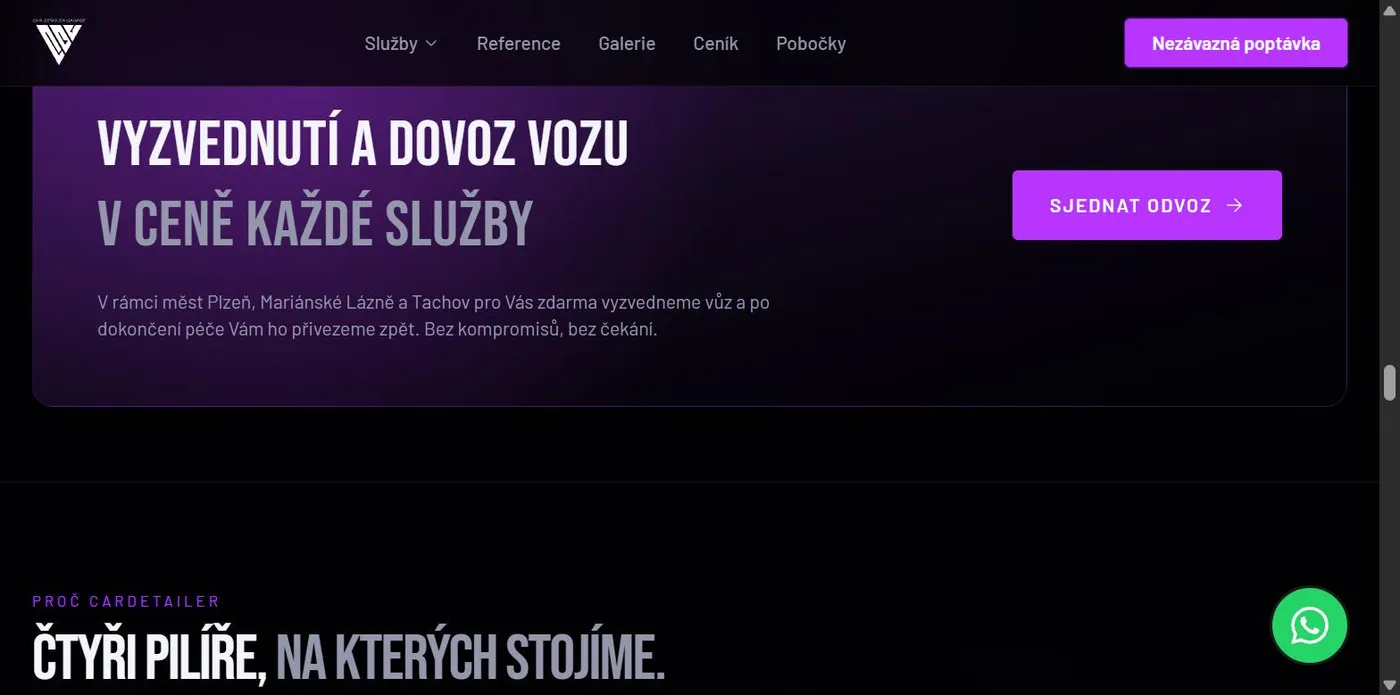
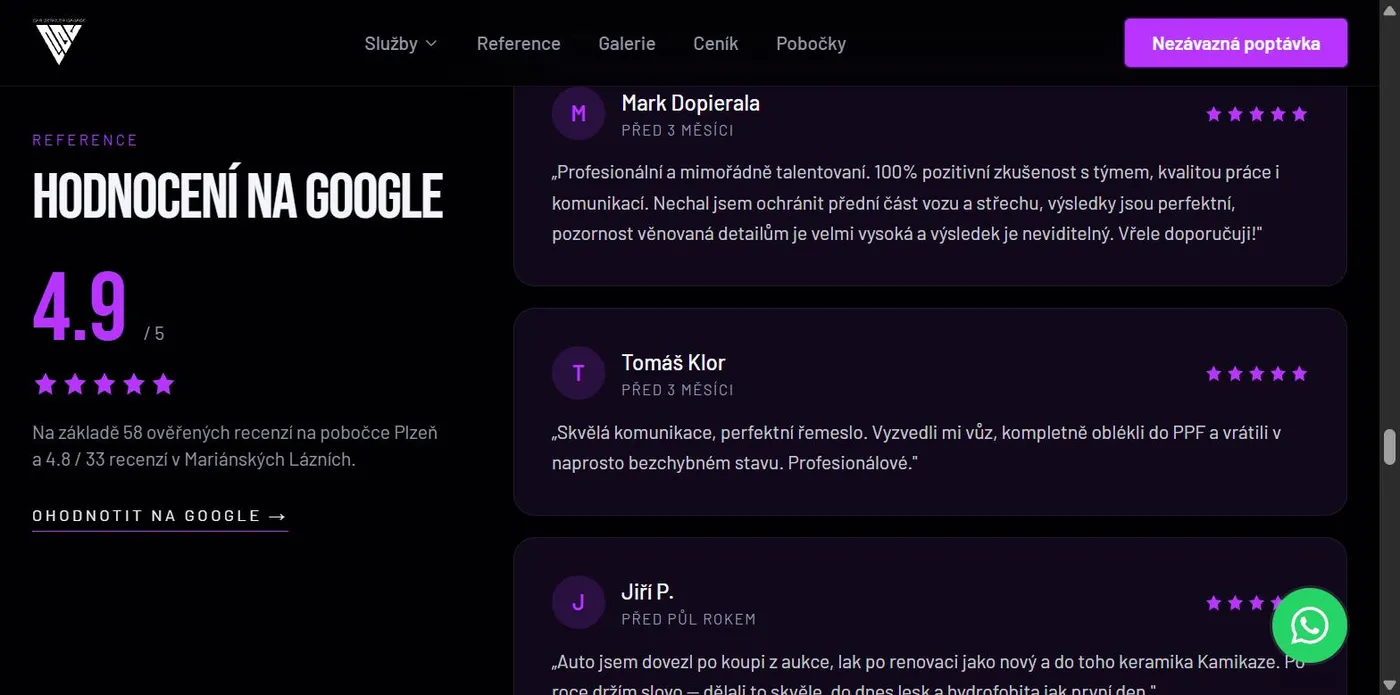
What changed once the new site went live on 3 July 2026. Where the client keeps absolute numbers private, the old site = 100.
Aug–Sep 2026 against Jan–Jun 2026, the last half-year on the old website.
Enquiry = a sent form or a call from an ad. One yardstick for the whole study.
Same day, same campaigns, same budget as the weeks before. Only the website changed.
Weekly enquiries in the website admin since launch.
All website enquiries in the first 10 weeks, against the old site’s level (owner’s estimate).
Old site ≈ 1 enquiry a week. First bar = that level.
With ad spend up 14 %. Year-on-year check in the same window: −34 %.
Index, old site = 100. Lower is better.
Ten weeks of the new website in three charts. Hover or tap a bar for the exact number.
Enquiries landing in the website admin, 3 Jul – 11 Sep 2026, as a percentage of the old site’s level (≈ 1 enquiry a week, according to the client).
The “enquiry form” conversion in the account; 100 = the Jan–Jun 2026 average, the last half-year on the old site.
How to read it: May and June — June already under our management — brought one form enquiry each. In July the site and tracking were switched over and Google Ads recorded no form enquiries (the website admin has them). August and September run at 240–279.
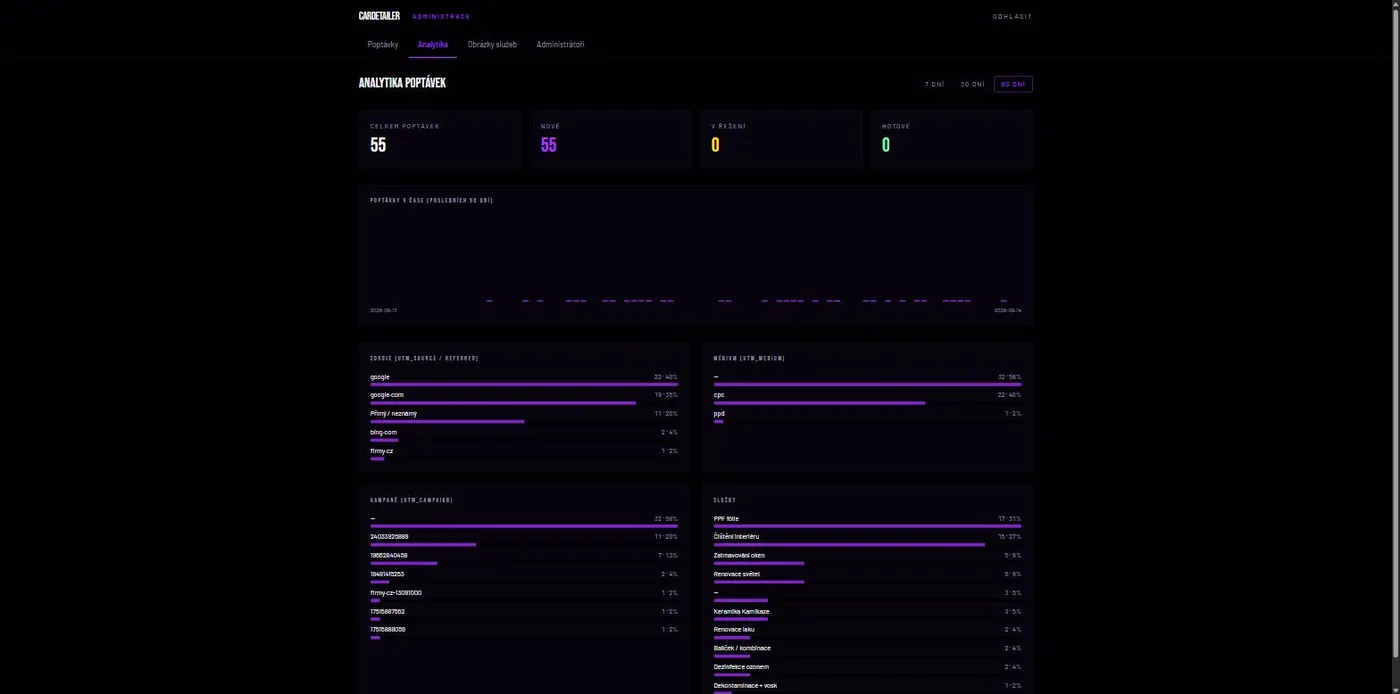
Where enquiries came from in the first 90 days of the new website, according to the admin.
How to read it: 40 % of enquiries come from paid clicks. The new site also lifted organic Google (35 %) and direct visits (20 %) — that is where most of the +430 % comes from.
Same account, same campaigns, a different website: January–June 2026 against 1 August – 13 September 2026. Swipe the cards; the full tables are underneath.
The headline result — forms plus calls from ads.
01 / 06Forms alone, without calls.
02 / 06More of the people the ads bring in actually ask for a quote.
03 / 06Cheaper clicks, partly thanks to the new PPF campaign.
04 / 06The budget was not quite the same — we say so.
05 / 06Lower is better. Down even after the extra spend.
06 / 06Jan–Jun 2026 vs. 1 Aug – 13 Sep 2026
| Metric | Old site | New site | Change |
|---|---|---|---|
| Enquiries from ads a month (index) | 100 | 255 | +155 % |
| of which sent forms (index) | 100 | 247 | +147 % |
| Click to enquiry | 0.32 % | 0.49 % | +53 % |
| Cost per click (index) | 100 | 68 | −32 % |
| Ad spend (index) | 100 | 114 | +14 % |
| Cost per enquiry from ads (index) | 100 | 45 | −55 % |
| Time to the first enquiry after launch | — | ≈ 5 min | 3 Jul 2026 8:26 |
1 Aug – 13 Sep 2025 (old site) vs. 2026 (new site)
| Metric | 2025 | 2026 | Change |
|---|---|---|---|
| Enquiries from ads (index) | 100 | 173 | +73 % |
| of which sent forms (index) | 100 | 162 | +62 % |
| Ad spend (index) | 100 | 115 | +15 % |
| Cost per enquiry from ads (index) | 100 | 66 | −34 % |
Why the second table: August and September are stronger months in detailing. Comparing the same calendar window a year earlier keeps the season from flattering the result — and it still shows +73 % enquiries at −34 % cost per enquiry.
Speed: one month in the account to the diagnosis, a new website live on 3 July, the first enquiry five minutes later.
Send us your site and access to your campaigns — we will tell you straight whether it is the ads or the website that needs work.
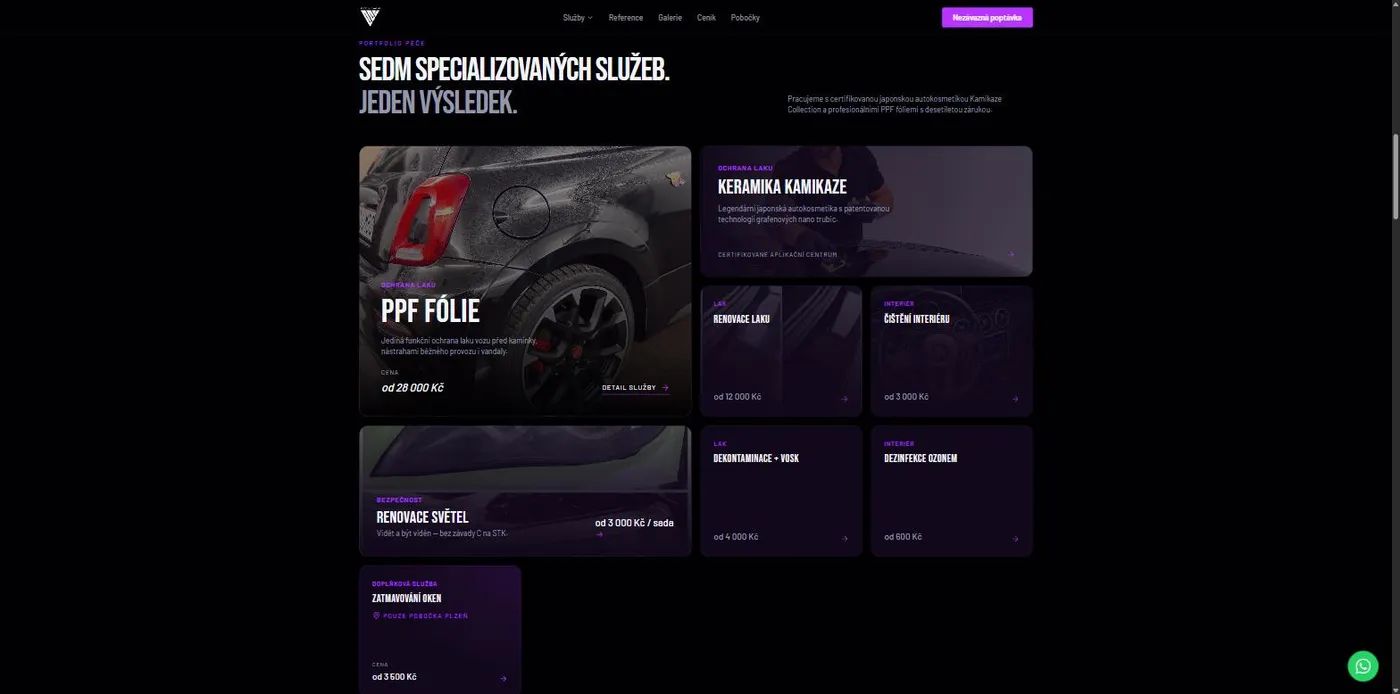
The old homepage next to the new one — and the two sections that sell the most.
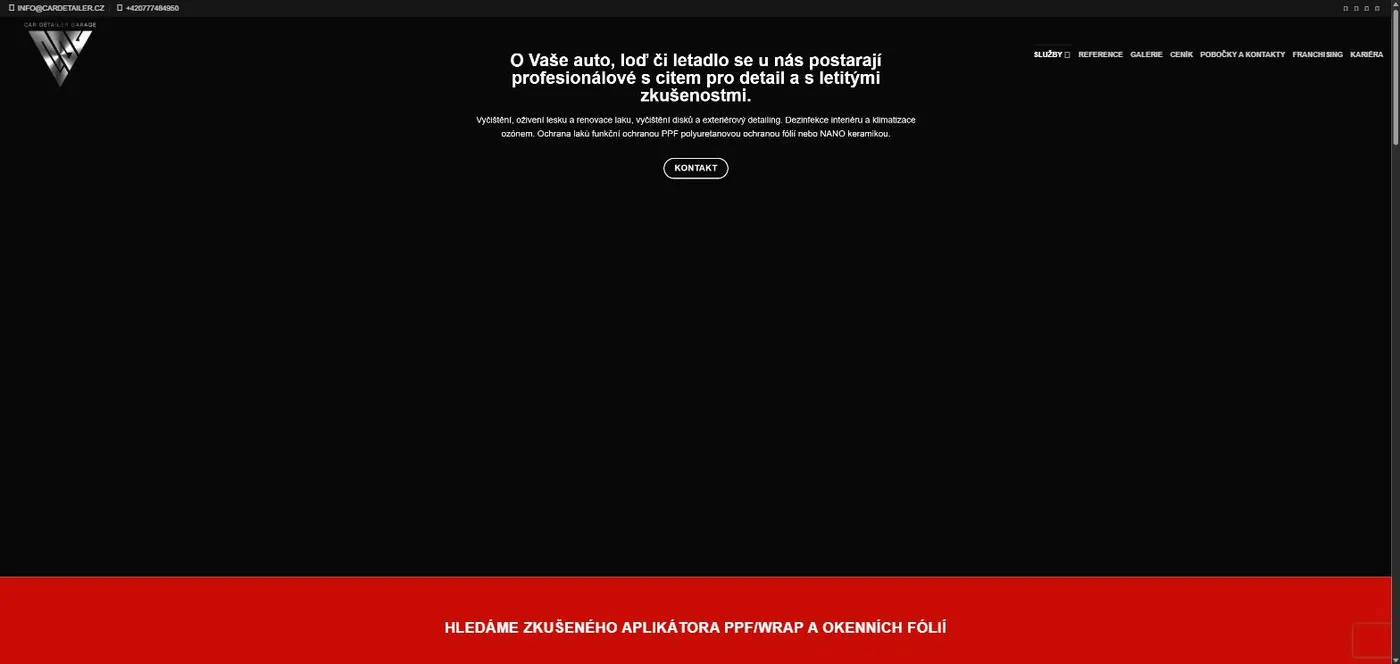
The old site is reconstructed from the Wayback Machine; some styles the archive did not keep were filled in from the site’s template.
CarDetailer is a premium detailing studio based in Plzeň, with branches in Mariánské Lázně and Tachov. The owner applies paint protection film himself, with a ten-year warranty; for Kamikaze Collection ceramics the studio is certified by the brand’s founder — one of few in Czechia. Every job starts with picking the car up and ends with bringing it back, included in the price.
The studio rates 4.9 out of 5 on Google. The craft was never the problem, nor was demand for it — PPF starts at 28,000 CZK and customers drive half the country for it. The problem was that the old website said almost nothing about any of this.
We took the account over on 1 June 2026. We cleaned it, straightened it out — and the whole of June brought one form enquiry.
What we found: campaigns learning from a soft signal. Almost half of what the account reported as a “conversion” was a click on the phone-number link — not a call, not an enquiry. Just a click. For months the algorithm hunted for people who tap the number and never call; in June alone it was two thirds of all reported conversions.
What we did about it:
Campaigns decide who comes to the website. They cannot decide what people do there.
Where it hit the ceiling
Month after month the ads brought thousands of visitors — over thirteen thousand clicks in the first half-year. They produced roughly one form enquiry a week. May brought one for the whole month, June — already ours — one too.
After a month we told the client the awkward sentence: we will not get more out of the ads. Not because the campaigns were wrong, but because the website holds the ceiling. And that cannot be tuned. It has to be rebuilt.
The old site was a business card from another era: beautifully silent about prices, hiding the enquiry, recruiting staff on the homepage.

We opened it through the eyes of a customer who has just clicked an ad for “PPF film Plzeň”, and looked at what awaited them:
Paid clicks went to this site for years — from June ours too. It could bring people in. It could not sell to them.
The whole site is built around one sentence: send us an enquiry, we will reply within 48 hours.

Not a template with the photos swapped — written from scratch for what CarDetailer sells and to whom. Every section has one job: move the visitor one step closer to a sent enquiry.
Name, phone, car, service — an enquiry in 30 seconds, with a reply promised within 48 hours.
Whoever comes from a PPF ad knows straight away we start at 28,000 CZK — enquiries are more serious.
The studio’s biggest benefit is now impossible to miss.
From consultation to handover, with photo documentation. Step eight is “send an enquiry”.
Verified reviews on the page — not quotes, proof.
No template or plugin ballast — a custom site loads before a visitor has time to change their mind.
Before you add budget to ads, look at your site through the eyes of someone arriving from an ad: can they tell within 10 seconds what you do, for how much and what to do next? If not, every extra crown only speeds up the exits.
Custom websites are one of our services — with a price calculator for new projects and running sites.
The website comes with an enquiry admin — and a bridge that sends real enquiries back into Google Ads.
We built a custom admin alongside the site: every enquiry lands there with the name, service and town — plus its source, campaign and click ID (GCLID). The studio team sees every enquiry in one place and marks what is new, in progress or done.
For us it is mainly fuel for the ads. One click exports conversions for Google Ads — by GCLID and as enhanced conversions, with email and phone hashed the way Google requires. The campaigns no longer learn from phone-number clicks but from real enquiries.
Same day, same campaigns, same budget as the weeks before. The only thing that changed was the website.

We clean the queries, narrow the geography, cut services the studio does not do and throw out soft conversions.
One form enquiry for the whole month. We tell the client the website is next.
The site goes live in the morning; the first enquiry lands before we finish checking the tracking.
Performance Max built for the most expensive service — today the account’s best campaign (20 % of enquiries).
The form is measured directly in Ads and via GCLID export from the admin — the campaigns learn from real enquiries.
With the budget back at its usual level. Next step: tighten the target cost per enquiry.
A studio the ads had been sending visitors to for years finally has a website that turns them into enquiries — and a system where none gets lost.

430 % more website enquiries than before; 155 % more from ads, at 55 % lower cost. A third want PPF, the priciest service.
One place for every enquiry: who, which service, where from and in what state. The team knows who to call first.
Real enquiries flow back into Google Ads by GCLID. Campaigns target people who enquire, not people who only click.
Everything that would make these numbers look better than they are, said out loud.
The season does part of the work. August and September are stronger in detailing than spring. Last year, on the old site and with no changes, enquiries between the same two windows jumped 87 % on their own. Without that correction the +155 % would look better than it really is.
So how much did the website really do? The fairest view is year on year in the same window: 1 Aug – 13 Sep brought 73 % more enquiries from ads than a year earlier. But the account was already 27 % stronger year on year before the website (Jan–Jun). Take that trend out too and the new website plus the new PPF campaign account for roughly +36 % measurable enquiries from ads. Much less than +155 %, and we say so.
The big jump is in the admin, not in the ads. The +430 % covers all website enquiries, not just paid ones: 35 % came from organic Google and 20 % direct. The old site had no admin, so it is compared with the owner’s memory (“about one enquiry a week”), not a measurement. “3× the enquiries” is the owner’s summary across all channels, not our measurement.
The budget was not quite the same. Against the first half-year we spent 14 % more, 15 % more year on year. Cost per enquiry fell even after that extra money. Part of the growth also comes from cheaper clicks in the new PPF campaign: +15 % spend brought 51 % more visitors year on year.
The rest. We took the account over one month before the launch — enough to clean and assess it, not to transform it. In July tracking was switched over with the site and Google Ads recorded no form enquiries that month; the website admin has them. The post-launch window is ten weeks so far; the new site has not lived through a full season yet.
Send this and you get a 90-day strategic plan for raising the performance of your marketing. Free, within 48 hours of account access.
Jan gets back to you within 48 hours, usually with two questions and a time. Then the 90-day plan starts.